

The digital publishing landscape is experiencing its most significant transformation since mobile optimization became mandatory. As a small to medium publisher, you’ve likely noticed changes in how traffic reaches your site—and you might be hearing new terms like “GEO” or “Generative Engine Optimization” floating around industry discussions.
Here’s what you need to know: while the terminology is evolving, the core principles of getting found online remain surprisingly consistent. This guide will help you understand the SEO vs GEO debate and, more importantly, build a sustainable strategy that works regardless of which search technology dominates tomorrow.
Contents
- 1 Understanding SEO vs GEO: The Fundamental Differences
- 2 How GEO Changes the Game for Publishers
- 3 Building a Sustainable Search Strategy: The E-E-A-T Framework
- 4 The “They Ask, You Answer” Approach: A Case Study
- 5 Practical SEO vs GEO Strategies for Small to Medium Publishers
- 6 When “De-Optimization” Is Actually a Smart Strategy
- 7 Technical Foundations That Matter for Both SEO and GEO
- 8 Common Mistakes Publishers Make in the SEO vs GEO Era
- 9 The Bottom Line on SEO vs GEO
- 10 Ready to Transform Your Ad Revenue?
Understanding SEO vs GEO: The Fundamental Differences
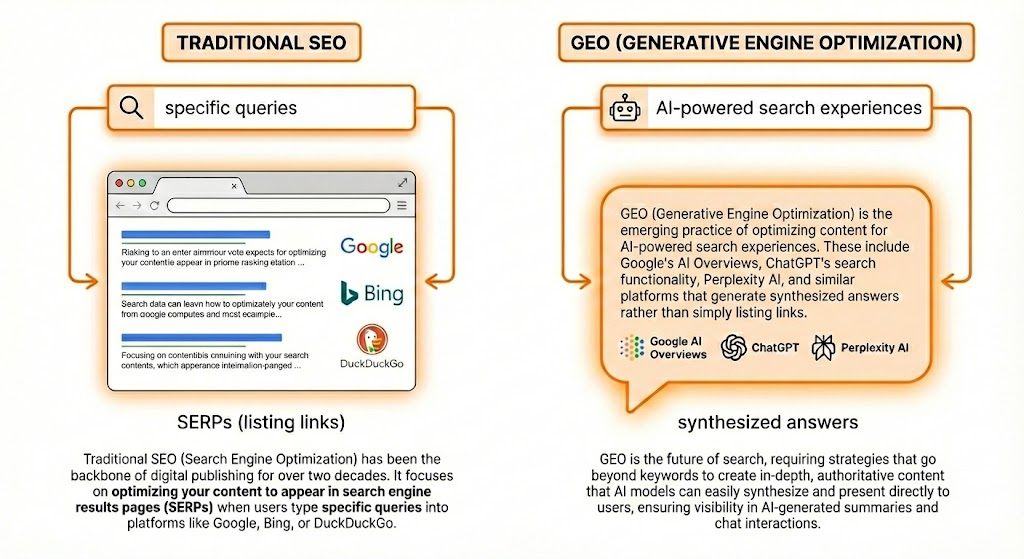
Traditional SEO (Search Engine Optimization) has been the backbone of digital publishing for over two decades. It focuses on optimizing your content to appear in search engine results pages (SERPs) when users type specific queries into platforms like Google, Bing, or DuckDuckGo.
GEO (Generative Engine Optimization) is the emerging practice of optimizing content for AI-powered search experiences. These include Google’s AI Overviews, ChatGPT’s search functionality, Perplexity AI, and similar platforms that generate synthesized answers rather than simply listing links.
The debate around terminology is ongoing. Google’s Danny Sullivan has pointed out the confusion: Should we call it GEO? AEO (Answer Engine Optimization)? Or stick with SEO as an umbrella term? The reality is that SEO has always evolved to encompass new search technologies, and this moment is no different.
What actually matters: Whether you’re optimizing for traditional search engines or AI-generated responses, you’re ultimately trying to connect your content with people seeking information. The medium may change, but the mission remains constant.
How GEO Changes the Game for Publishers
Understanding SEO vs GEO requires recognizing three key shifts:
1. From Exact Keywords to Conversational Context
Traditional SEO often emphasized exact-match keywords and specific phrases. AI-powered search, however, understands natural language, context, and intent. When someone asks ChatGPT or uses Google’s AI features, they’re more likely to phrase queries as complete questions: “What’s the best way for small publishers to increase ad revenue?” rather than simply “publisher ad revenue tips.”
This doesn’t mean keywords are dead—it means you need to think beyond keyword density and toward answering complete questions comprehensively. If you’re looking to refine your approach to keyword targeting for both traditional and AI search, our comprehensive keyword research guide breaks down modern strategies that work across all search platforms.
2. Direct Answers Mean Different Traffic Patterns
AI Overviews and chatbot responses often provide synthesized answers directly within the search interface. For publishers, this creates a paradox: you might see fewer clicks, but the clicks you do get are from more qualified visitors who’ve already consumed basic information and want deeper insights.
According to data from Google, users who click through after viewing AI Overviews tend to have higher engagement rates because they’re already in an informed state. They’re not clicking to learn “what” something is—they’re clicking to learn “how” or to access specific resources.
3. Content Synthesis from Multiple Sources
Unlike traditional search results that list individual pages, AI systems combine information from multiple sources to create unified answers. This means your content competes not just for ranking position, but for inclusion in that synthesized response.
The implication? Being the single best source on a narrow topic is more valuable than being one of many mediocre sources on a broad topic.
Building a Sustainable Search Strategy: The E-E-A-T Framework
When discussing SEO vs GEO, the conversation inevitably leads to sustainability. Short-term tactics that game algorithms don’t work long-term—whether you’re targeting traditional search or AI platforms.
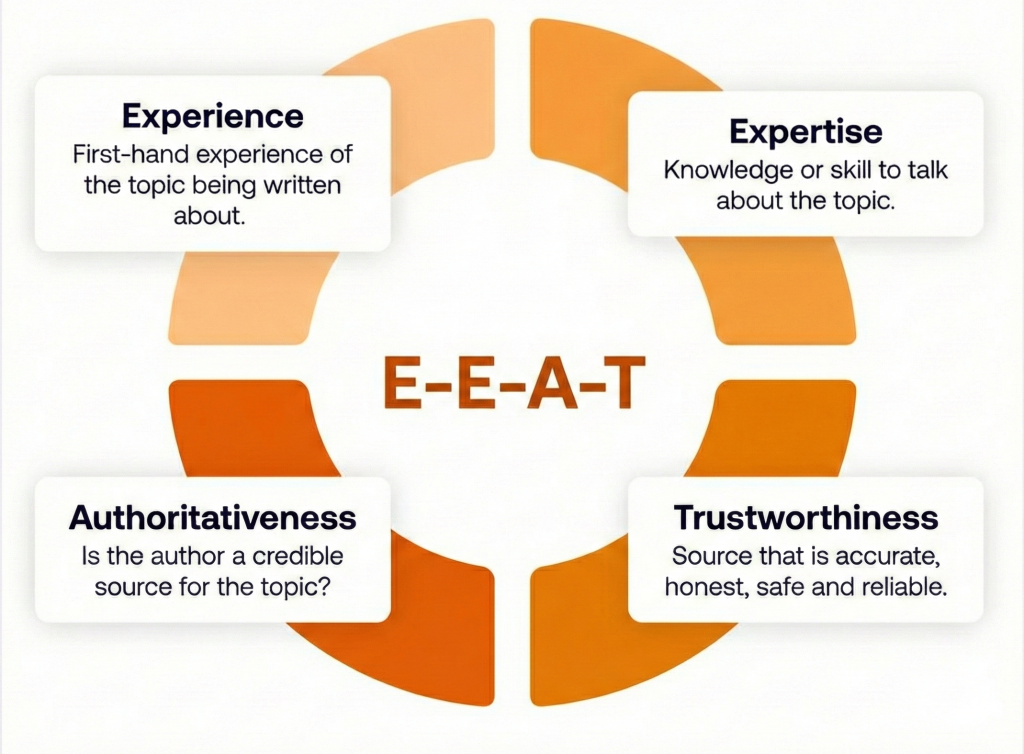
Google’s quality guidelines emphasize E-E-A-T:
- Experience: Have you actually done what you’re writing about? For publishers covering ad monetization, have you implemented these strategies yourself?
- Expertise: Do you possess deep knowledge in your subject area?
- Authoritativeness: Are you recognized as a credible voice in your niche?
- Trust: Is your information accurate, transparent, and reliable?
For small to medium publishers, E-E-A-T isn’t about having a Ph.D. or being the world’s leading expert. It’s about being genuinely helpful within your specific niche. A lifestyle blogger who’s systematically tested 20 different monetization strategies has real experience and expertise—even if they’re not a marketing professor.
Why E-E-A-T matters for both SEO and GEO:
Traditional search engines use E-E-A-T signals to determine which content deserves high rankings. AI systems training on web content similarly prioritize authoritative, trustworthy sources when generating responses. By focusing on E-E-A-T, you’re future-proofing your content strategy regardless of technological shifts.
The “They Ask, You Answer” Approach: A Case Study
One of the most powerful examples of sustainable search strategy comes from Marcus Sheridan’s book “They Ask, You Answer” and his company, River Pools and Spas.
During the 2008 financial crisis, with his business on the brink of failure, Sheridan made a radical decision: he would answer every question customers asked him—including the questions his competitors avoided, especially pricing.
He published an article titled “How Much Does a Fiberglass Pool Cost?” At the time, no one in the industry publicly discussed pricing. They wanted customers to call so they could control the conversation.
Sheridan’s article provided transparent price ranges, explained factors affecting cost, and helped readers understand what they were actually buying. That single article generated over $6 million in revenue and became one of the most successful pieces of content marketing in history.
The lesson for publishers:
When thinking about SEO vs GEO strategies, ask yourself: What questions are your audience asking that nobody’s answering honestly? For publishers, these might include:
- “How much traffic do I really need to make money from ads?”
- “What are the actual CPM rates I can expect as a small publisher?”
- “Why did my ad revenue drop last month?”
- “Should I use Google AdSense or header bidding?”
Answering these questions transparently—even when the answers aren’t comfortable—builds the trust that both search engines and AI systems reward.
Practical SEO vs GEO Strategies for Small to Medium Publishers
Now for the actionable part. Here’s how to optimize your publishing strategy for both traditional search and AI-powered platforms:
1. Write for Natural Language Queries
Instead of targeting keyword phrases like “increase CPM publishers,” create content that answers specific questions:
- “Why is my CPM lower than industry averages?” (and provide genuine diagnostic steps)
- “What’s a realistic CPM for a lifestyle blog with 50,000 monthly visitors?” (with real data)
- “How do I increase my CPM without annoying readers?” (with tested strategies)
2. Provide Comprehensive, First-Hand Insights
AI systems and search engines both favor content that demonstrates real experience. When discussing ad optimization strategies:
- Share actual numbers from your own implementation
- Include screenshots of your dashboard (with sensitive data redacted)
- Discuss what didn’t work, not just successes
- Provide step-by-step guides based on what you’ve actually done
For more guidance on creating content that satisfies both search engines and readers, check out our SEO-optimized article writing guide which covers structuring content for maximum impact in the AI era.
3. Structure Content for AI Understanding
Make it easy for both humans and AI to extract information:
- Use clear headings that pose questions or state topics directly
- Include concise summaries or key takeaways
- Structure comparisons in tables when appropriate
- Define technical terms in context
- Use bullet points for lists of items or steps
4. Build Topic Authority, Not Just Page Rankings
Rather than creating isolated articles targeting different keywords, build comprehensive content hubs. If you’re covering ad monetization:
- Create a pillar page explaining ad monetization fundamentals
- Develop detailed guides on specific strategies (header bidding, direct deals, video ads)
- Publish case studies showing real results
- Link these pieces together logically
This approach works for both traditional SEO (internal linking signals) and GEO (AI systems can reference your comprehensive coverage). Proper keyword research helps you identify which topics deserve pillar content and which should be supporting articles.
5. Maintain Content Freshness
This is often overlooked when discussing SEO vs GEO, but it’s critical for publishers:
- Update statistics and data regularly
- Revise guides when platforms change their interfaces
- Add new sections as strategies evolve
- Mark outdated information clearly or redirect to updated versions
A two-year-old article about “best ad networks” might rank well but damage your credibility if it recommends networks that have since closed or changed their terms.
When “De-Optimization” Is Actually a Smart Strategy
Here’s a counterintuitive insight: sometimes ranking for the wrong keywords hurts more than it helps.
Google’s own documentation team faced this issue with their “Removals documentation” page. It ranked highly for generic terms like “how to remove website from Google,” but was actually intended for website owners wanting to remove their own content—not everyday users trying to remove personal information they found in search results.
The result? The page attracted the wrong audience, generated negative feedback, and created support burden. Google’s solution was to “de-optimize” by making the title and content more specific to the intended audience.
For publishers, de-optimization might mean:
- Removing generic keywords if they attract visitors who can’t use your monetization strategies (e.g., people with 100 monthly visitors when your content assumes 10,000+)
- Being more specific in titles even if it reduces traffic (e.g., “Header Bidding for Medium-Traffic Publishers” instead of just “Header Bidding Guide”)
- Clarifying prerequisites upfront so unqualified traffic leaves immediately rather than creating poor engagement metrics
Quality traffic that engages and converts is infinitely more valuable than high-volume traffic that bounces. This principle applies equally to SEO and GEO.
Technical Foundations That Matter for Both SEO and GEO
While content is king, technical excellence is the kingdom it rules. Here are non-negotiable technical factors:
1. Core Web Vitals and Page Experience
Google’s page experience signals matter for traditional SEO, and fast-loading, smooth-functioning sites also benefit from better user engagement—which AI systems can detect through behavioral signals.
Focus on:
- Reducing page load time (especially for ad-heavy pages)
- Ensuring mobile responsiveness
- Minimizing layout shifts as ads load
- Providing a clean, navigable structure
2. Proper Content Maintenance
Set up a system to review and update content quarterly. Check for:
- Outdated statistics or examples
- Broken links (especially to partner pages or external resources)
- Changed platform interfaces or features
- New regulations affecting publishers (like privacy laws)
3. Smart robots.txt Usage
Never use robots.txt to hide sensitive information—it’s a polite suggestion to crawlers, not a security measure. If you have pages you don’t want indexed:
- Use proper noindex meta tags
- Implement authentication for truly private content
- Consider the difference between “shouldn’t be crawled” and “shouldn’t be public”
Common Mistakes Publishers Make in the SEO vs GEO Era
Mistake #1: AI-Generated Content Spam
Using AI to pump out dozens of thin articles might temporarily increase indexed pages, but it destroys E-E-A-T. Both search engines and AI platforms are getting better at detecting low-value, mass-produced content.
Better approach: Use AI as a research and outlining tool, but ensure final content includes your genuine experience, unique insights, and editorial oversight. Our guide to writing SEO-optimized articles explains how to balance efficiency with quality.
Mistake #2: Ignoring User Intent
Ranking for “ad revenue” sounds great until you realize those visitors might be advertisers looking to spend money, not publishers looking to make money. Understanding the intent behind keywords prevents wasted optimization effort.
Mistake #3: Keyword Stuffing for AI
Some publishers think they need to repeat keywords obsessively for AI systems to understand their content. In reality, modern AI understands semantic relationships and context—over-optimization can actually hurt readability and credibility.
Mistake #4: Neglecting Link Building
Links remain important for both SEO and GEO. For traditional SEO, they’re a ranking signal. For AI systems, links help determine which sources are authoritative enough to cite or reference.
Focus on earning links through:
- Publishing genuinely useful, link-worthy content
- Building relationships with other publishers in your niche
- Contributing expertise to industry discussions
- Creating tools, calculators, or resources others want to reference
The Bottom Line on SEO vs GEO
The debate between SEO vs GEO is ultimately a distraction from what really matters: creating content that genuinely helps your audience.
Traditional search engines want to surface the best answers to user queries. AI systems want to provide accurate, helpful information from trustworthy sources. Both goals align when you focus on experience, expertise, authority, and trust.
The technology will continue evolving—mobile changed everything, voice search shifted behaviors, and AI is transforming how people find information. But through all these changes, one constant remains: high-quality content from credible publishers finds its audience.
As a small to medium publisher, you have advantages that large corporate sites lack: authenticity, agility, and genuine connection with your niche audience. By committing to transparency, answering real questions honestly, and maintaining high standards, you’ll build sustainable traffic regardless of whether people find you through traditional search, AI overviews, or technologies that haven’t been invented yet.
Ready to Transform Your Ad Revenue?
At PubPower, we help small to medium publishers maximize ad revenue through transparent header bidding technology. Unlike traditional ad networks that operate as “black boxes,” we provide complete visibility into your bidding, real-time reporting, and tools specifically designed for publishers without large technical teams.
What makes PubPower different:
- Self-serve header bidding platform with 30+ integrated SSPs
- No technical team required—set up in minutes
- Complete transparency with real-time reporting on CPM, bid rates, and win rates
- AdBlock recovery tools that restore 10-20% of lost revenue
- Dedicated support that actually responds quickly
Whether you’re earning $500 or $50,000 monthly from ads, we have solutions that scale with your growth. Start with our free trial to see the difference transparency makes.