

For publishers, organic traffic is the lifeblood of monetization. But in today’s programmatic ecosystem, not all traffic is valued equally by ad exchanges. To maximize your yield, you must understand how search engines evaluate your site, especially E‑E‑A‑T for publishers—and how those evaluations directly influence the bids you receive from enterprise media buyers.
Key Takeaways:
- E-E-A-T (Experience, Expertise, Authoritativeness, Trustworthiness) is the defining framework Google uses to evaluate publisher content quality and allocate organic traffic.
- High E-E-A-T directly impacts programmatic revenue by driving high-intent users with longer session durations, significantly increasing ad viewability and bidder competition.
- YMYL (Your Money or Your Life) niches face the strictest E-E-A-T scrutiny; failing to meet these standards results in both search ranking drops and blacklisted ad inventory by enterprise buyers.
- Publishers combining strong E-E-A-T SEO with a transparent header bidding setup typically see a revenue uplift compared to traditional AdSense monetization.
Contents
- 1 What is E-E-A-T in the Context of Publisher Monetization?
- 2 The Evolution from E-A-T to E-E-A-T (Why “Experience” Matters)
- 3 The YMYL Intersection: Why Your Niche Dictates Your SEO Strategy
- 4 The Domino Effect: How E-E-A-T Directly Impacts Programmatic Ad Revenue
- 5 Why Enterprise Media Buyers Target High-Trust Inventory
- 6 Actionable Steps to Build E-E-A-T for Your Publishing Site Today
- 7 High-Quality Content Deserves Premium Yield: The PubPower Approach
- 8 The End of the Black Box Monetization
- 9 FAQs
What is E-E-A-T in the Context of Publisher Monetization?
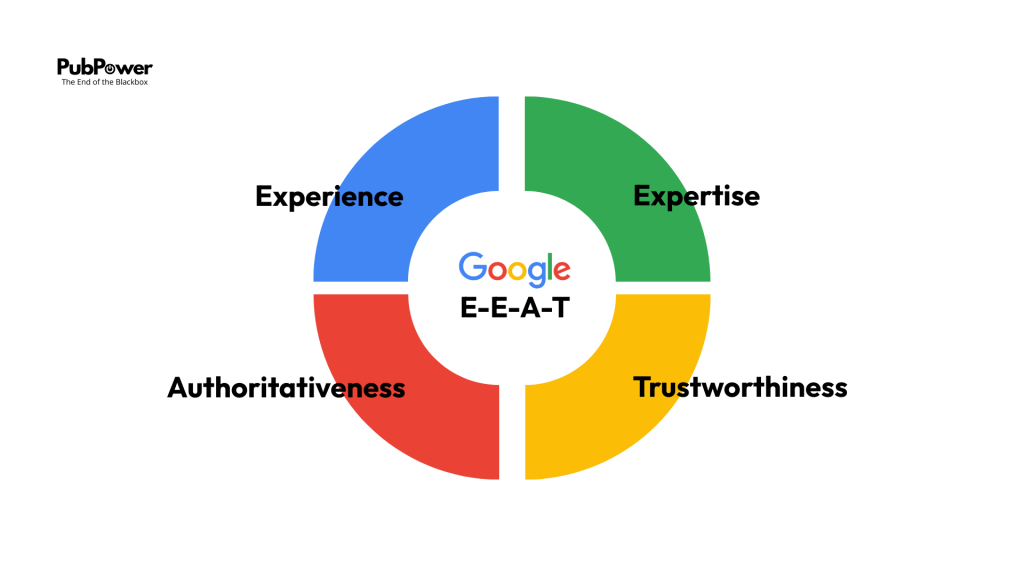
E-E-A-T stands for Experience, Expertise, Authoritativeness, and Trustworthiness. For publishers, it is Google’s primary framework for evaluating content quality, directly determining organic traffic volume and, consequently, the inherent value of your ad inventory in programmatic auctions.
Many publishers mistakenly view E-E-A-T purely as an SEO checklist. In reality, it is a revenue-defining metric.
When your site demonstrates high E-E-A-T, you attract a high-intent, highly engaged audience. In the programmatic ecosystem, this translates to tangible ad performance metrics: higher session depths, increased viewability, and lower bounce rates. When DSPs (Demand-Side Platforms) detect these positive user signals on your domain, their bidding algorithms recognize the quality of the audience and bid far more aggressively for your impressions.
Ultimately, content authority is the foundation of yield optimization. You cannot negotiate premium CPMs from top-tier SSPs if your traffic consists of low-engagement users bouncing from thin content.
The Evolution from E-A-T to E-E-A-T (Why “Experience” Matters)
In late 2022, Google added “Experience” to its Search Quality Rater Guidelines, penalizing generic AI-generated content and rewarding first-hand knowledge. Publishers must now prove hands-on interaction and authentic perspectives within their topics to maintain the high-intent traffic that advertisers demand.
Before the generative AI boom, the standard E-A-T (Expertise, Authoritativeness, Trustworthiness) framework was sufficient for most publishers. However, as the web became flooded with commoditized, AI-spun articles, Google updated its framework to prioritize verifiable human experience.
For a publisher’s editorial and AdOps teams, this algorithm shift requires a strategic pivot. Generic listicles and scraped news roundups are no longer viable for sustainable monetization. If you run a technology review site, your content needs original photos of the hardware and real-world testing data. If you operate a personal finance blog, you need authentic insights that prove you have actually utilized the financial products you are discussing.
Media buyers on premium ad exchanges do not want their brand’s creatives placed next to scraped AI content. They are willing to pay a premium exclusively for engaged, human readers who trust the publication they are reading.
The YMYL Intersection: Why Your Niche Dictates Your SEO Strategy
YMYL (Your Money or Your Life) refers to content affecting users’ financial stability, health, safety, or legal rights. Advertisers and SSPs heavily scrutinize YMYL publishers for brand safety, meaning strict E-E-A-T compliance is non-negotiable to avoid algorithmic penalties and blocked ad monetization.
For publishers operating in high-stakes niches—such as personal finance, medical advice, or legal compliance—Google applies a magnifying glass to your content. But the scrutiny doesn’t stop at the search engine level. It extends directly into the programmatic auction pipeline.
While standard consumer content falls under YMYL, B2B publishers face an equally rigorous standard known in the industry as YMYB (Your Money, Your Business). If your content advises other enterprises on SaaS investments, corporate financial planning, or operational strategies, you are held to these same uncompromising trust thresholds.
Here is the programmatic reality: Demand-Side Platforms (DSPs) do not bid blindly. Enterprise advertisers deploy sophisticated third-party brand safety tools—such as Integral Ad Science (IAS) or DoubleVerify—to scan page context in milliseconds. If your YMYL or YMYB site lacks verifiable E-E-A-T signals, these tools flag your domain as a high-risk environment. The result? The DSP filters out your inventory before a bid is ever placed.
When top-tier advertisers block your domain, your auction density collapses. You are left relying on lower-tier ad networks, which drastically reduces your CPMs. Understanding how brand safety impacts your fill ratesis critical because no header bidding wrapper can optimize a page that premium buyers refuse to touch. By actively demonstrating E-E-A-T, you are not just pleasing search algorithms; you are actively whitelisting your inventory for the highest-paying enterprise campaigns.
The Domino Effect: How E-E-A-T Directly Impacts Programmatic Ad Revenue
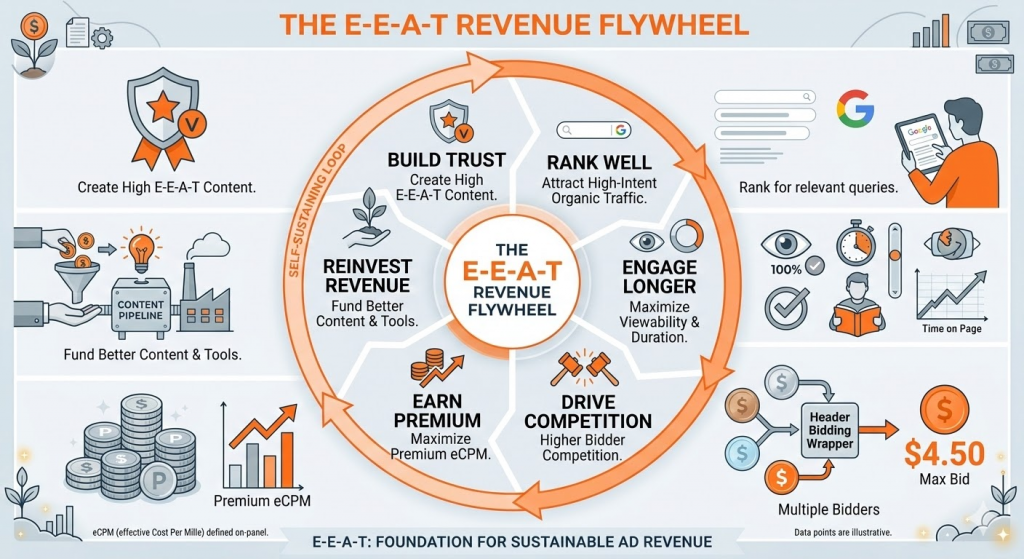
High E-E-A-T signals generate stable, high-intent organic traffic with substantially longer session durations. This increased viewability alerts enterprise media buyers and top SSPs in a header bidding auction, driving up real-time competition and resulting in premium eCPMs for the publisher.
To understand this dynamic, you must look at how search algorithms and programmatic bidding algorithms interact. Search engines reward high E-E-A-T content with top rankings, bringing in users who are genuinely searching for answers. Because the content is authoritative and trustworthy, these users do not bounce; they read, scroll, and engage.
In the programmatic ecosystem, this on-page engagement translates directly into higher “viewability”—a critical metric measuring how long an ad is actually seen by a human user. When a publisher utilizes a unified auction (where multiple ad exchanges bid simultaneously before the ad server decides the winner), historical viewability data plays a massive role. Think of the unified auction like a live stock market for your ad inventory: when historical data shows that users linger on your highly trusted content, SSPs will aggressively bid up the floor price to secure that premium placement.
To visualize this compounding growth, we map out the exact sequence from content creation to revenue realization.
Why Enterprise Media Buyers Target High-Trust Inventory
Premium brands are increasingly protective of where their ads appear. Buyers utilize Private Marketplaces (PMPs) and strict allowlists to exclusively target publishers with established topical authority, willing to pay significantly higher CPMs for the brand safety that high E-E-A-T provides.
According to recent industry data surrounding the shift of ad spend toward premium environments, buyers are increasingly heavily consolidating their budgets into trusted channels. As noted in the eMarketer Programmatic Ad Spending Report, brand-safe publisher environments and curated marketplaces are absorbing the majority of new programmatic growth.
When your site demonstrates clear Expertise and Trustworthiness, buyers place your domain on highly lucrative allowlists. This gives you access to Private Marketplaces (PMPs), where advertisers offer fixed, premium CPMs that simply do not exist on the open market. The impact on your bottom line is immediate and measurable once the right programmatic infrastructure is in place.
Actionable Steps to Build E-E-A-T for Your Publishing Site Today
To build verifiable E-E-A-T, publishers must implement robust author bios, transparent editorial guidelines, rigorous fact-checking protocols, proper Schema markup, and compliant privacy frameworks to satisfy both search engine algorithms and premium ad tech platforms.
To help you systematically address these requirements, we have compiled a comprehensive framework you can apply directly to your site.
Technical SEO and Schema Markup for Trust Signals
Beyond visible content, search engines rely on structured data to verify publisher identity. Implementing correct Author Schema, Article Schema, and Publisher Organization Schema definitively links your content to real-world experts, reinforcing the “Expertise” and “Trust” pillars at the code level.
While well-written author biographies and “About Us” pages are essential for human readers, search engine crawlers rely on structured data—specifically Schema markup—to process these relationships efficiently. When you wrap your content in Article and Person schema, you explicitly tell Google: This specific article was written by this verifiable expert, who is associated with this legitimate publishing organization.
However, publishers must be cautious during implementation.
Transparent Consent and Ads.txt Compliance
Trustworthiness extends to how you handle user data and ad inventory authorization. Maintaining a flawless, continuously updated Ads.txt file and utilizing a transparent Cookie Consent Management Platform (CMP) proves to SSPs and Google that your operations are legitimate and compliant.
Trust is fundamentally about transparency. For a publisher, this means being completely transparent with your audience about data collection and completely transparent with buyers about who is authorized to sell your ad space.
Implementing a robust Consent Management Platform (CMP) ensures compliance with global privacy regulations like GDPR and CCPA. Without valid user consent strings passed through the bid stream, major DSPs simply will not bid on your European or Californian traffic.
Equally important is your Ads.txt file. This public ledger tells the programmatic ecosystem exactly which SSPs and exchanges are authorized to sell your inventory. A messy or outdated file signals to buyers that your inventory might be susceptible to domain spoofing or unauthorized reselling, instantly lowering your trust score and your eCPMs. For step-by-step instructions on securing your inventory, review our complete guide to managing your Ads.txt file.
High-Quality Content Deserves Premium Yield: The PubPower Approach
Once your E-E-A-T strategy secures high-value traffic, legacy ad setups like standard AdSense leave money on the table. PubPower’s self-serve header bidding platform connects your trusted, authoritative inventory to over 30 premium SSPs, ensuring your content receives the maximum possible bid.
Building E-E-A-T requires significant investment in editorial resources, expert contributors, and technical SEO. If you successfully execute this strategy but continue to rely on a single ad network, you are inherently under-monetizing your hard work.
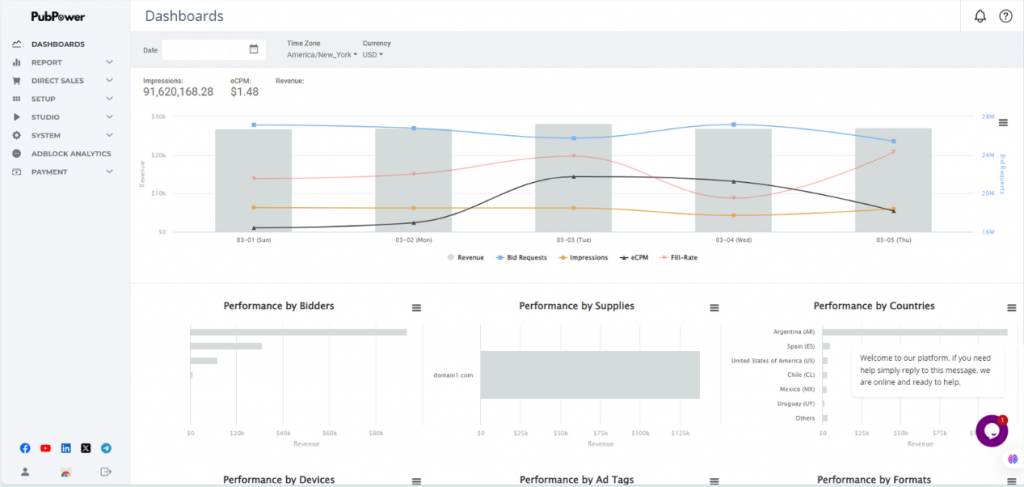
A single network, even one as large as Google AdSense, only represents a fraction of the total programmatic demand available. To truly capitalize on your high-trust inventory, you must expose it to maximum competition. This is achieved through header bidding—a technology that allows multiple SSPs (Supply-Side Platforms) to evaluate your user’s context and bid simultaneously before the ad server makes a decision. When premium buyers from platforms like PubMatic, Magnite, and Amazon compete directly with Google for your highly engaged users, your yield increases dramatically.
Here is what that competition looks like in practice when managed through a unified interface.
The End of the Black Box Monetization
Unlike opaque managed services that hide their revenue share and lock you into long contracts, PubPower empowers publishers with absolute transparency. You retain full control over your layout, maintain your SEO performance, and see exactly what each SSP is bidding in real-time.
With PubPower’s self-serve model, you dictate the ad density, protecting your SEO rankings while still accessing tier-one demand. Stop leaving ad revenue on the table. If you have done the hard work to build E-E-A-T and secure high-intent traffic, See how much your high-quality content is actually worth with PubPower. Book a demo today.
You’re right, the current draft doesn’t have any FAQ section at the end.[docs.google]
Here’s a focused 4-question FAQ block you can add (BOFU‑leaning, still educational):
FAQ
1. What is E‑E‑A‑T for publishers?
E‑E‑A‑T for publishers is Google’s quality framework (Experience, Expertise, Authoritativeness, Trustworthiness) applied to editorial content, authors, and site reputation, which directly influences how much organic traffic your site receives.[docs.google]
2. How does E‑E‑A‑T affect my ad revenue?
High E‑E‑A‑T attracts high‑intent, engaged users who stay longer on page, increasing viewability and driving more aggressive bids from premium programmatic buyers.[docs.google]
3. Why is E‑E‑A‑T critical for YMYL and B2B sites?
In YMYL and YMYB niches, weak E‑E‑A‑T can cause ranking drops and trigger brand‑safety tools to block or filter your inventory from enterprise campaigns entirely.[docs.google]
4. Do I still need header bidding if I improve E‑E‑A‑T?
Yes. Strong E‑E‑A‑T creates valuable traffic, but you need a transparent, multi‑SSP header bidding stack to expose that inventory to maximum premium demand and fully monetize it.[docs.google]
____________
FAQs
1. What is Google E‑E‑A‑T?
Google E‑E‑A‑T is Google’s quality framework (Experience, Expertise, Authoritativeness, Trustworthiness) applied to editorial content, authors, and site reputation, which directly influences how much organic traffic your site receives.
2. How does E‑E‑A‑T affect my ad revenue?
High E‑E‑A‑T attracts high‑intent, engaged users who stay longer on page, increasing viewability and driving more aggressive bids from premium programmatic buyers.
3. Why is E‑E‑A‑T critical for YMYL and B2B sites?
In YMYL and YMYB niches, weak E‑E‑A‑T can cause ranking drops and trigger brand‑safety tools to block or filter your inventory from enterprise campaigns entirely.
4. Do I still need header bidding if I improve E‑E‑A‑T?
Yes. Strong E‑E‑A‑T creates valuable traffic, but you need a transparent, multi‑SSP header bidding stack to expose that inventory to maximum premium demand and fully monetize it.
Bạn muốn FAQ này giữ vendor‑neutral hay mình thêm một câu hỏi nhẹ về “How does PubPower help high‑E‑E‑A‑T publishers monetize?” để gắn với CTA?