

For years, digital publishers accepted a frustrating reality: ad inventory was sold in a sequential, often opaque “waterfall” where historical data—not real-time demand—dictated the price. If you’ve searched “what is header bidding,” your current setup has likely capped your revenue. You know there has to be a better way to sell your impressions. Header bidding is the answer. It’s a model where multiple SSPs and ad networks bid on the same impression simultaneously. Your ad server then decides who wins, so the market sets the price instead of your old waterfall history.
This guide breaks down exactly what header bidding is and how it works. You’ll learn why it beats AdSense-only or waterfall setups on CPM and transparency. We also cover where self-serve platforms like PubPower fit in if you don’t have an in-house AdOps dev team. By the end, you’ll be able to spot where money is leaking from your auctions. You’ll also know whether moving to header bidding is worth the engineering and operational change for your site.
Contents
Key Takeaways
- Header bidding is an advanced programmatic technique. It allows publishers to offer ad inventory to multiple ad exchanges (SSPs) simultaneously before calling the primary ad server.
- By replacing the inefficient, historical “waterfall” model with a real-time, parallel auction, publishers increase competition and typically see a lift in overall ad revenue
- The core technology uses a JavaScript wrapper (like Prebid.js). It manages timeouts to protect page speed while collecting the highest bids.
- Setting up header bidding manually requires developer resources. Self-serve platforms like PubPower automate the process, connecting publishers to 30+ SSPs without complex coding.
1. The Core Definition: What is Header Bidding?
Header bidding is a programmatic setup where multiple SSPs and ad networks bid on the same impression at the same time. This happens before your ad server makes a decision. Instead of giving one partner “first look,” you turn every impression into a mini auction that runs in the user’s browser while the page loads.
In practical terms, you drop a small JavaScript wrapper (most publishers use Prebid.js) into the of your site. That wrapper reads which ad slots are on the page. It fires bid requests to your connected SSPs. After a tightly controlled timeout, it hands the winning bid to your ad server like Google Ad Manager. Prebid is open-source, maintained at Prebid.org. The auction logic is public, auditable, and not owned by any single vendor.
Header Bidding vs. The Traditional Waterfall
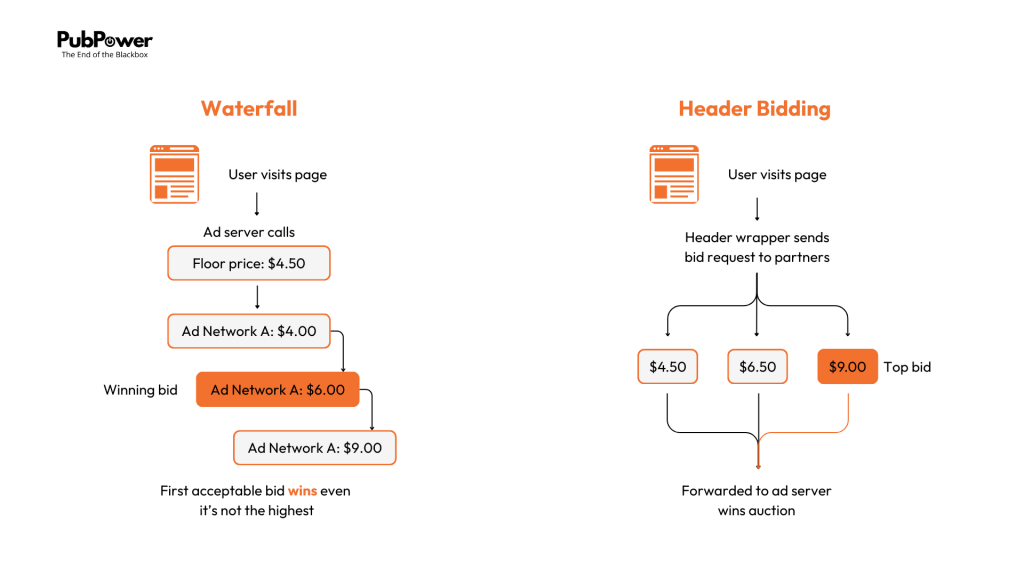
Before header bidding, publishers used a “waterfall” model. Ad networks were called one by one based on historical average prices. Header bidding replaces this with a parallel, real-time auction. Everyone bids at once, and the highest price wins.
Header bidding eliminates this inefficiency. Instead of a line, think of it as a crowded auction house where every SSP sees the impression simultaneously. The $4.20 buyer wins immediately. This shift from historical averages to real-time competition is the exact mechanism that drives the 20-40% revenue uplift publishers experience when moving away from standard AdSense or waterfall setups.
2. The Mechanics: How Header Bidding Works Step-by-Step
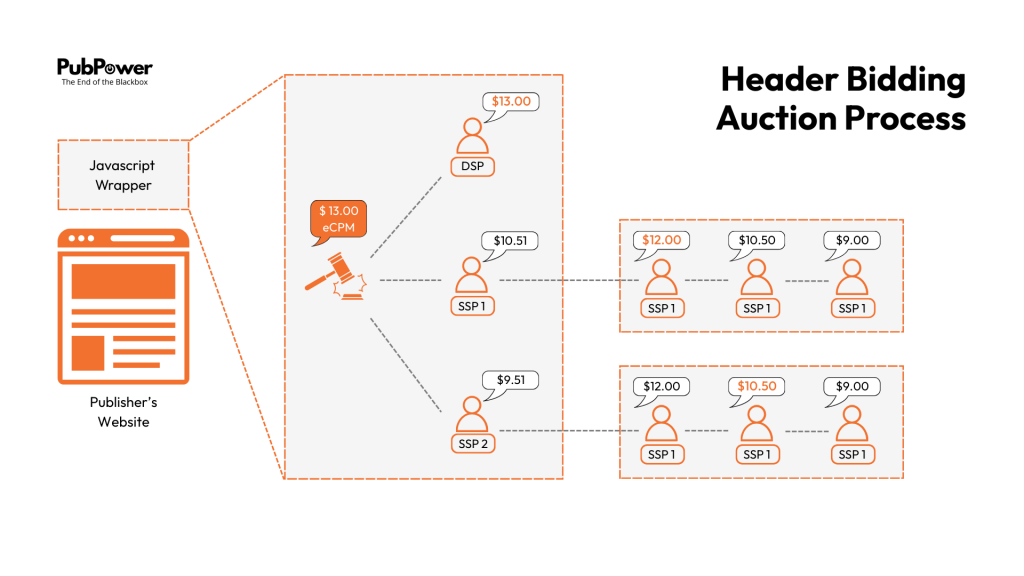
The header bidding process happens in milliseconds. When a user visits a page, a piece of code (the wrapper) pauses the ad server, requests bids from multiple SSPs simultaneously, collects the highest offers within a strict time limit, and then passes the winner to the ad server to display the ad.
Understanding this flow is crucial for AdOps managers looking to troubleshoot their setups or explain programmatic strategy to stakeholders. While it involves complex HTTP requests, JSON bid responses, and real-time data processing, the entire auction is designed to conclude before the user even finishes reading the headline of your article.
Step 1: The Page Loads and the Wrapper Fires
As soon as a visitor opens your website, the header bidding wrapper (usually built on Prebid.js) embedded in the page’s HTML header is triggered. This code acts as the auctioneer for your ad slots.
This wrapper is the conductor of the orchestra. Before any main content or primary ad server scripts execute, the wrapper initiates the pre-bid phase. It reads the page environment, identifies the available ad units (like a 728×90 leaderboard or a 300×250 sidebar), and prepares to notify the market that inventory is available.
Step 2: Simultaneous Bid Requests to SSPs
The wrapper instantly sends out requests to all your connected Supply-Side Platforms (SSPs). Instead of waiting in line, every demand partner gets the exact same opportunity to evaluate the user and submit a bid at the exact same time.
These bid requests contain vital parameters such as the ad unit size, placement ID, and anonymized user data (like device type or geolocation). Because the requests are sent in parallel rather than sequentially, you avoid the latency issues of the old waterfall model. Dozens of SSPs—and the DSPs connected behind them—evaluate the impression and use algorithms to calculate their maximum willingness to pay.
Step 3: The Timeout Limit
To prevent the website from loading slowly, the wrapper enforces a strict “timeout” limit (typically 500 to 1000 milliseconds). If an SSP does not return a bid within this window, they are excluded from the auction, protecting your user’s experience.
Balancing this timeout is an essential AdOps skill. If the duration is set too long (e.g., 3000ms), you risk delaying the ad render and hurting your viewability scores; if it is set too short (e.g., 200ms), top-paying bidders might not have enough time to respond, directly reducing your revenue. Prebid only accepts bids that arrive within this predefined window—anything later is registered as a “timeout” and ignored.
Step 4: Selecting the Winner inside the Ad Server
Once the timeout hits, the wrapper identifies the highest bid from the SSPs and passes it to your ad server (like Google Ad Manager). The ad server then compares this header bidding winner against its own direct campaigns and AdX demand, finally serving the ad that pays you the most.
This is the post-bid phase. The wrapper packages the winning bid’s price and creative information into key-values and sends it to the ad server. Inside Google Ad Manager, this header bidding bid is entered into a final, unified auction. It competes directly against your guaranteed direct-sold campaigns and Google’s own Ad Exchange (AdX). Whichever source offers the highest value for that specific impression wins the right to display their creative to the user.
3. Why Do Publishers Need Header Bidding?
Publishers need header bidding because it maximizes the value of every single ad impression. By increasing competition, unlocking data transparency, and improving fill rates, publishers migrating from AdSense or waterfall setups typically experience a 20-40% increase in total ad revenue.
If you are a publisher generating over 100,000 monthly sessions, relying on a single network like AdSense means you are artificially limiting your earning potential. Header bidding transforms monetization from a passive process into a competitive, strategic advantage. By opening up your inventory to the global programmatic ecosystem, you force buyers to pay what your audience is actually worth.
Increased CPMs and Total Revenue
When multiple exchanges compete simultaneously for an impression, buyers are forced to bid their true maximum price rather than settling for a historical average. This intense, real-time competition directly drives up your Cost Per Mille (CPM) and overall yield.
In a waterfall setup, if the first network in line meets your floor price, they win the impression—even if another buyer further down the line would have paid double. Header bidding fixes this by ensuring true market pricing: every impression is exposed to multiple demand sources at the same time. Because buyers know they are competing in a unified auction, they must submit their highest competitive bid to win.
Total Transparency (Ending the Black Box)
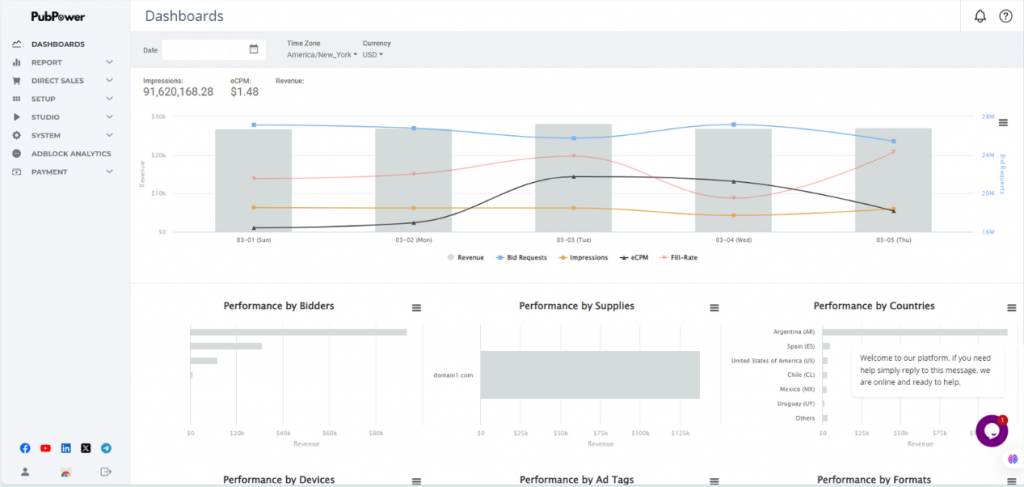
Header bidding gives publishers granular, log-level visibility into their auctions. You can see exactly which SSPs are bidding, how much they are offering, and who is winning, eliminating the opaque “black box” of traditional ad networks.
Transparency is one of the most powerful—yet often overlooked—benefits of open-source header bidding. Unlike closed ad networks where you only see the final revenue payout, header bidding allows your AdOps team to access log-level data. This means you can track the exact bid requests, identify which SSPs consistently bid high but lose due to timeouts, and understand exactly how much value each partner brings to your stack. This level of data empowers publishers to negotiate better direct deals and optimize their floor prices with mathematical precision.
Higher Fill Rates
Because your inventory is exposed to dozens of demand sources globally at the exact same time, the likelihood of an impression going unsold drops dramatically. More bidders naturally lead to a near-100% fill rate for high-quality traffic.
A low fill rate means you are displaying blank spaces instead of ads—literally throwing money away. When you use a header bidding wrapper connected to 30+ SSPs (like the PubPower setup), you are instantly tapping into the advertiser rosters of every major exchange in the world. If one network doesn’t have a relevant ad for a specific user, another network almost certainly will. This density of demand ensures that your ad slots are consistently filled, capturing revenue on every possible pageview.
4. The Challenges of DIY Header Bidding (And the Solution)
While the financial benefits are clear, building a header bidding stack from scratch is highly complex. It requires a dedicated AdOps and developer team to manage code updates, maintain SSP relationships, and monitor latency to prevent page speed issues.
Header bidding is powerful, but it is not a “set-it-and-forget-it” technology. If you decide to build and manage your own Prebid.js wrapper, you are essentially taking on the role of a software development agency. You have to integrate multiple bidder adapters, configure price granularity in your ad server, map thousands of line items, and continuously test the setup across different browsers and devices. For publishers without an in-house AdOps engineering team, this initial setup and ongoing maintenance can quickly become overwhelming.
Latency is the most critical risk of a DIY setup. Client-side header bidding runs entirely within the user’s browser; if your wrapper forces the browser to wait too long for SSPs to respond, the entire webpage slows down. This poor user experience can negatively impact your SEO rankings and lead to ad-call timeouts, which ultimately reduces the very revenue you are trying to increase.
The Solution: Self-Serve Wrapper Platforms
Self-serve platforms like PubPower eliminate the technical barriers of header bidding. Instead of writing code, publishers simply install a single, lightweight script that instantly connects them to a fully optimized, pre-configured wrapper with 30+ premium SSPs.
By using a managed self-serve platform, you get the absolute best of both worlds: the revenue-boosting power of an enterprise-grade header bidding stack, without the massive engineering overhead. You don’t need to sign individual contracts with dozens of exchanges or manually update Prebid.js every time a new version is released.
PubPower’s platform is designed to handle the heavy lifting parts of setup and maintenance. You retain full control and transparency over your auction, but you manage it through an intuitive interface rather than digging through lines of JavaScript. Contact us now!
5. Frequently Asked Questions (People Also Ask)
Transitioning to advanced programmatic monetization naturally raises technical questions. Here are the most common concerns publishers have when considering a move to header bidding.
Is header bidding better than AdSense?
Yes. AdSense is a single network with limited demand, meaning you only get what Google’s buyers are willing to pay. Header bidding forces AdSense (via Google AdX) to compete against dozens of other premium networks, guaranteeing you always get the highest possible price.
Does header bidding slow down my website?
It can, if configured poorly. However, a modern, optimized wrapper uses strict timeouts, asynchronous loading, and selective bidder calls to ensure that the ad auction happens in the background without affecting your Core Web Vitals or user experience.
Is header bidding only for large enterprise publishers?
Historically, yes, because of the heavy development costs. Today, thanks to self-serve platforms, publishers with as few as 100,000 monthly pageviews can easily access the exact same enterprise-level header bidding technology and premium SSPs.