
If you’ve been using aggressive monetization tactics to squeeze more pageviews out of every visitor — or if you’re running third-party scripts from an ad network, recommendation widget, or affiliate tool that you haven’t fully audited — read this carefully. Google started enforcing its new spam policy on back button hijacking, April 13, 2026. This isn’t an algorithm update you can recover from in a few weeks. It’s a manual action risk — the kind that can take your site off Google Search entirely until the issue is resolved.
We’re writing this because some of the scripts and tools publishers commonly use — including ad-related libraries — can cause this violation without you realizing it. As your ad network partner, we want you to understand exactly what’s happening, what’s at risk, and what you should do today.
Contents
- 1 Key takeaways:
- 2 What Is Back Button Hijacking?
- 3 Why This Is Bigger Than a Policy Update
- 4 The Revenue Damage Goes Deeper Than a Penalty
- 5 What Publishers Should Check Today
- 6 The Gray Area: “Back Button Detection” vs. “Back Button Hijacking”
- 7 The Publisher-Partner Relationship on Policy
- 8 Frequently asked questions (FAQs)
Key takeaways:
- Google now treats back button hijacking as spam and can issue manual penalties starting June 15, 2026.
- You’re liable even if a third‑party ad or widget script causes the hijacking on your site.
- Trapping users hurts long‑term SEO and revenue by generating negative Navboost user signals.
- PubPower’s stack does not alter browser history and helps publishers audit scripts to stay compliant and protect rankings.
What Is Back Button Hijacking?
It sounds technical, but the user experience is simple and deeply frustrating.
You visit a site from Google Search. You read the article. You press the Back button to return to Google. Instead of going back, you’re sent to a feed page full of “recommended articles,” an interstitial ad page, or you’re just stuck — pressing Back repeatedly but never leaving the site.
That’s back button hijacking. The site has used the browser’s History API (history.pushState or history.replaceState) to insert fake entries into your browser history, effectively trapping you inside their domain to generate more pageviews and ad impressions.
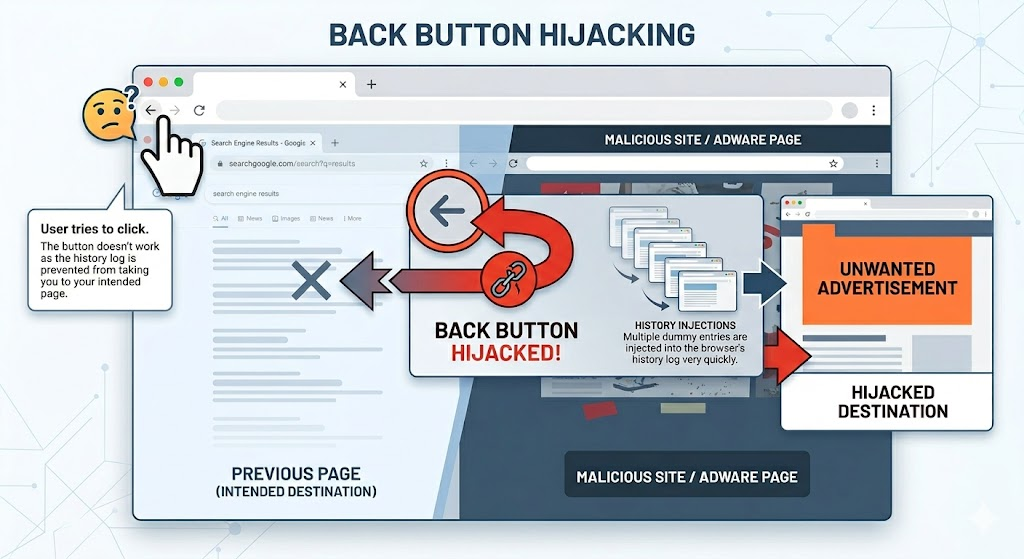
From a short-term revenue perspective, the logic is obvious: more pageviews = more impressions = more revenue. But from Google’s perspective, effective June 15, 2026, this is classified as malicious spam behavior — the same category as cloaking and deceptive redirects.
Why This Is Bigger Than a Policy Update
Most SEO penalties hit your rankings. You lose some traffic, you fix the issue, you recover over months.
A manual action for back button hijacking is different. It can result in:
- Full or partial removal from Google Search results
- Loss of Google Discover eligibility
- Restrictions on Google Ads monetization on your domain
- A reinclusion request process that takes weeks or months
And here’s what makes this particularly important for publishers working with ad networks: Google explicitly states that you — the site owner — are responsible for back button hijacking, even if the script causing it came from a third-party platform.
“Some instances of back button hijacking may originate from the site’s included libraries or advertising platform.” — Google Search Central, April 13, 2026
That means if a script from any platform in your stack — an ad network, a recommendation widget, an exit-intent tool, a video player — is manipulating your users’ back button behavior, your domain receives the penalty, not the vendor.
The Revenue Damage Goes Deeper Than a Penalty
Even before any manual action, back button hijacking is actively damaging your long-term revenue through a mechanism most publishers don’t know about: Navboost.
Navboost is Google’s click-based re-ranking system. It tracks how users interact with search results over a rolling 13-month window — not just whether they clicked on your result, but what happened after. Did they stay and read? Or did they immediately try to escape and return to Google?
When your visitors are trapped by a hijacked back button, they try to leave repeatedly. They eventually find a way out — closing the tab, typing in the URL directly, or force-navigating. From Navboost’s perspective, this registers as:
- A “bad click” — the user returned to Google quickly and without satisfaction
- A low-dwell-time session — they didn’t engage meaningfully with your content
- A negative quality signal that accumulates month over month
Over 13 months of this pattern, your site’s rankings erode — often slowly and silently, without a visible penalty notification. You lose organic traffic. You serve fewer ad impressions. Revenue drops — and the very tactic designed to inflate it becomes the thing destroying it.
What Publishers Should Check Today
Whether you’re running PubPower, another ad network, or a mix of monetization tools, here’s a practical audit you can do right now:
Test 1 — The Manual Back Button Test Open your site in a fresh browser window using a Google Search result (not a direct URL). Scroll through a few pages. Then press Back. You should land immediately on Google Search results. If you’re sent to a feed page, a “you might also like” page, or nothing happens — you have a problem.
Do this across:
- Your homepage and top 5 landing pages
- Mobile (Chrome on Android, Safari on iPhone)
- Desktop (Chrome, Firefox)
Test 2 — Browser History Inspection Open Chrome DevTools → Sources → Search for pushState or replaceState. If either is being called on page load (before any user interaction), that’s a red flag. These calls should only fire in response to intentional navigation actions, not automatically on page entry.
Test 3 — Script Isolation If you find a problem, disable your monetization scripts one by one (use a tag manager or test environment) to identify which vendor or library is the source. Common culprits include:
- Recommendation widget scripts (Taboola, Outbrain integrations, or lookalike tools)
- Exit-intent popup libraries
- Aggressive ad tag configurations that inject history entries
- Video player autoplay scripts
The Gray Area: “Back Button Detection” vs. “Back Button Hijacking”
One thing worth flagging: some publishers and platforms have responded to Google’s policy by replacing hijacking scripts with back button detection — triggering a popup or exit overlay the moment a user moves toward the Back button.
This likely doesn’t violate the current spam policy. But it creates the same frustrated-user experience that Navboost measures. Trapped users and ambushed users both generate the same negative engagement signals.
Our recommendation: don’t replace one manipulation with another. Build revenue on content quality and auction competition, not UX friction. The publishers we work with who have the most stable, growing revenue are invariably the ones whose users choose to stay — not the ones whose users can’t find a way to leave.
The Publisher-Partner Relationship on Policy
We’ve been working with publishers since 2019. One thing we’ve learned is that policy violations almost always trace back to a transparency gap — a publisher who didn’t know a script was doing something harmful, or a network that didn’t communicate clearly about what its tags were doing.
That’s why we built PubPower around the principle of “The End of the Black Box.” You should see every script, every bidder, every demand source, and exactly what it’s doing on your pages in real time.
If you’re running another network’s tags alongside ours, you deserve that same transparency from them. If you can’t get it — that’s worth asking yourself whether that partnership is one you want to keep.
Need help auditing your setup? Contact your PubPower account manager or reach out at [email protected]. We’re here.
Frequently asked questions (FAQs)
Q: What is back button hijacking in publishing?
A: Back button hijacking is when a website manipulates the browser’s History API to prevent users from using the Back button normally. Instead of returning to Google Search or the previous page, users are redirected to ad-heavy feeds, interstitials, or kept in a navigation loop to generate extra pageviews and ad impressions.
Q: Will back button hijacking get my site penalized by Google?
A: Yes. Google enforces back button hijacking as a spam violation that can result in manual actions, ranking demotions, and removal from Google Search results or Discover.
Q: Can an ad network script cause back button hijacking on my site?
A: Yes. Google explicitly notes that back button hijacking can originate from third-party libraries or advertising platforms. The site owner is still responsible for any violation, regardless of the script’s source.
Q: How do I check if my site has a back button hijacking problem?
A: Arrive at your site via a Google Search click, browse naturally, then press Back. You should return to Google immediately. Also check browser DevTools (Sources tab) for pushState or replaceState calls firing automatically on page load.