

The way ad impressions are sold has fundamentally changed — and most publishers don’t realize how much that change affects their bottom line. Since Google Ad Manager completed its switch to first-price auctions in 2019, the entire programmatic ecosystem has operated under new rules. Yet the opacity around how first-price vs second-price auction actually settle — who takes what cut, and why your eCPM fluctuates without explanation — remains a defining frustration for publishers worldwide.
This article breaks down exactly how first-price vs second-price auctions work, what the industry shift means for your revenue today, and what transparent reporting infrastructure publishers need to stop leaving money on the table.
Contents
- 1 Key Takeaways (TL;DR)
- 2 What Is a First-Price Auction? (And Why It Changed Everything)
- 3 Why the Industry Abandoned Second-Price Auctions
- 4 Is First-Price Better for Publishers? The Real Revenue Picture
- 5 The Hidden Transparency Problem No One Talks About: SSP Take Rates
- 6 Price Floor Strategy: Your Primary Defense in a First-Price World
- 7 What Auction Transparency Actually Looks Like: The PubPower Difference
- 8 FAQ Section
Key Takeaways (TL;DR)
- First-price auctions mean the winning bidder pays exactly what they bid — no automatic “second-price discount.” Publishers receive the full clearing price, minus SSP fees.
- The industry fully transitioned to first-price auctions between 2017–2020, led by major SSPs and finalized by Google Ad Manager in 2019.
- Bid shading — a DSP-side algorithm that deliberately lowers bids to the minimum needed to win — can reduce publisher CPMs by up to 20% in first-price environments.
- Hidden SSP take rates, ranging from 7% to 42% on the same publisher’s inventory, represent a second transparency gap that most platforms never expose in their reporting.
- Publishers using platforms with granular bid-level reporting can set data-driven price floors to counter both bid shading and undisclosed fees — recapturing revenue that would otherwise be invisible.
What Is a First-Price Auction? (And Why It Changed Everything)
A first-price auction is a programmatic model where the highest bidder wins the impression and pays exactly what they bid — no discounts, no post-auction adjustments. This model became the industry standard across all major SSPs and Google Ad Manager by 2020, replacing second-price mechanics that had dominated programmatic since its inception.
For publishers, this transition represented a fundamental shift toward transparency. Instead of relying on complex, opaque algorithms to determine the final clearing price, the math became straightforward. However, to truly understand why this shift was necessary—and how to optimize for it today—you must first understand the exact mechanics of how these auctions settle.
The Mechanics: How a First-Price Auction Settles
In a first-price environment, the auction process is entirely literal. When multiple demand sources compete for your ad inventory, the highest submitted bid is the exact amount charged to the advertiser.
Consider a standard scenario with three competing buyers:
- Advertiser A bids $5.00 CPM
- Advertiser B bids $4.20 CPM
- Advertiser C bids $3.80 CPM
Advertiser A wins the impression and pays exactly $5.00 CPM (their full bid). The publisher then receives that $5.00 minus the SSP take rate. For example, if the agreed SSP fee is 15%, the publisher nets $4.25. There is no hidden discount mechanism. What is bid is what is paid.
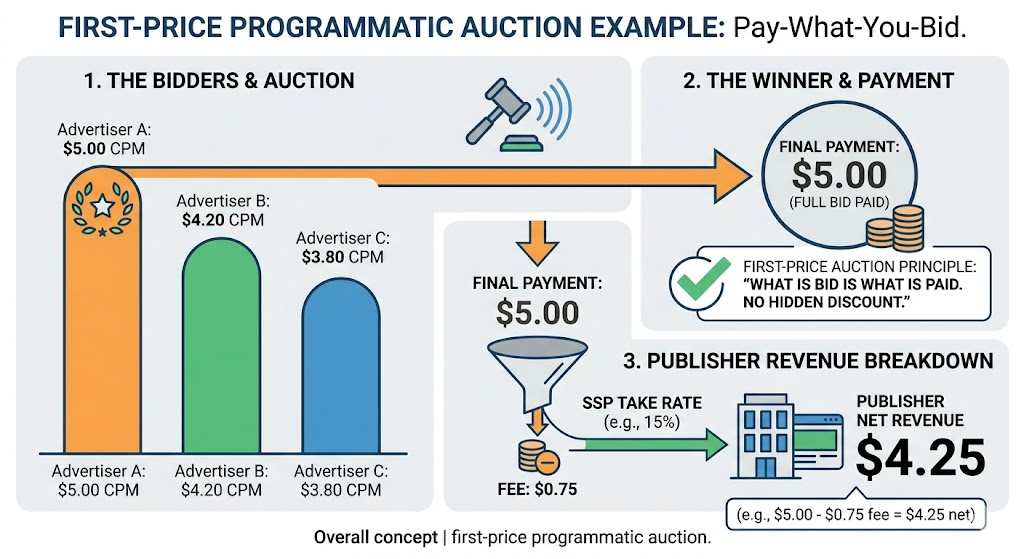
This direct correlation between the bid and the payout gives publishers a clear baseline for their inventory’s value, making yield optimization highly actionable.
How This Differs from Second-Price (Vickrey) Auctions
In a second-price auction, the winner pays the second-highest bid plus $0.01 — not their own bid. This design, originally meant to encourage truthful bidding, created systematic opportunities for hidden manipulation: SSPs could set undisclosed “soft floors” to force higher clearing prices while keeping the difference, and publishers rarely saw the true winning bid.
Using the exact same bidders from the previous example:
- Advertiser A bids $5.00 CPM
- Advertiser B bids $4.20 CPM
Under second-price rules, Advertiser A still wins the auction, but they only pay $4.21 (Advertiser B’s bid plus one cent). The publisher “gains” a $4.21 clearing price, but remains completely blind to the fact that Advertiser A was actually willing to pay $5.00 for that user.
This gap between the true bid and the final clearing price created a massive layer of opacity that severely disadvantaged publishers. It allowed intermediaries to utilize “soft floors.” SSPs could secretly set a floor just above the second bid, extracting the excess value from the gap without passing that revenue down to the publisher.
Because publishers rarely had access to log-level data or true bid metrics, they were forced to accept the reported clearing price as the true market value of their inventory. The first-price auction eliminated this specific black box, though as we will explore, it did not eliminate all hidden costs.
Why the Industry Abandoned Second-Price Auctions
The programmatic industry moved away from second-price auctions because header bidding made them incompatible. When publishers began running simultaneous first-price header bidding wrappers alongside Google’s second-price exchange, a two-stage distortion emerged: SSPs artificially inflated bids to win header bidding competitions, only for prices to be discounted by Google’s second-price logic — creating an uneven playing field that disadvantaged honest bidders and publishers alike.
The Header Bidding Incompatibility Problem
Header bidding fundamentally disrupted the traditional waterfall model. It empowered publishers to offer their inventory to multiple SSPs simultaneously before calling the ad server. Inside the header bidding wrapper, the auction operates on a strict first-price basis. The highest bid simply wins the wrapper competition.
However, a massive structural conflict occurred when that winning bid passed into Google Ad Exchange (AdX). Google was still using a second-price model. If an independent SSP submitted a winning $5.00 bid from the header, Google’s second-price logic would often reduce that clearing price based on its own internal auction density.
Publishers instantly lost the premium the SSP actually offered.
To survive this volatile mixed-auction environment, Demand-Side Platforms (DSPs) began deploying aggressive bid shading algorithms. They strategically manipulated bids to avoid overpaying across the distorted hybrid system. As a result, publishers could no longer trust their reported eCPMs. The numbers reflected a broken technical bridge, not the true market value of their ad inventory.
Google’s Transition: The Official Shift (2019)
The two-stage auction chaos became mathematically and operationally unsustainable. In May 2019, Google Ad Manager officially announced its global switch to a unified first-price auction.
Google stated the move was designed to create a fair and transparent marketplace. More importantly, it forced necessary alignment between Google’s massive inventory pool and how the rest of the independent programmatic ecosystem already operated.
Following Google’s massive infrastructure update, the rest of the industry had no choice but to adapt. Major independent SSPs like PubMatic, Magnite, Index Exchange, and Xandr fully completed their first-price transitions by the end of 2020.
To formalize this new transparent era, the industry needed unified technical standards. The IAB Tech Lab aggressively updated its OpenRTB specifications to standardize first-price auction signals across all platforms. This ensured that buyers and sellers finally spoke the same auction language.
Is First-Price Better for Publishers? The Real Revenue Picture
First-price auctions generally produce higher publisher revenue — 78% of publishers reported revenue increases after the switch . However, the gains are partially offset by bid shading, where DSP algorithms deliberately underbid to maximize advertiser efficiency, reducing publisher CPMs by up to 20%.
The Upside: Full Bid Revenue + Competitive Pressure
In a first-price model, publishers receive 100% of the clearing price before SSP fee deductions. You no longer suffer the immediate revenue haircut of a second-price mechanic. What the buyer bids is what the auction clears at.
When combined with header bidding, this creates genuine, aggressive price competition. Multiple SSPs bid simultaneously, and the absolute highest bid wins the impression. This direct transparency makes your price floors highly effective. Because the auction settles at the exact bid price, publishers can set strict minimums to protect their inventory value. You do not have to worry about SSPs secretly manipulating soft floors.
Transparent bid data enables yield optimization that was simply impossible under second-price opacity. When you can see the true winning bids, you can adjust your strategy based on reality.
The Offsetting Force: Bid Shading
Bid shading is a DSP-side optimization algorithm that analyzes historical auction data to identify the minimum bid needed to win a given impression, then submits that lower amount instead of the advertiser’s true maximum. In first-price environments, bid shading directly transfers value from publishers to advertisers — reducing CPMs by an estimated up to 20% depending on inventory category.
Major Demand-Side Platforms (DSPs) like The Trade Desk, DV360, and Amazon DSP all deploy bid shading algorithms. Their goal is to protect advertiser budgets in a first-price world. As a result, the “first-price” clearing prices publishers see are often algorithmically minimized before the auction even happens.
This algorithmic underbidding can reduce average CPMs by up to 20% compared to the true market value. Temporary market shifts, such as heavy political advertising cycles, can further accelerate or suppress this impact. Your only effective defense is deploying accurate price floors calibrated to actual bid distribution data, rather than guesswork.
The Hidden Transparency Problem No One Talks About: SSP Take Rates
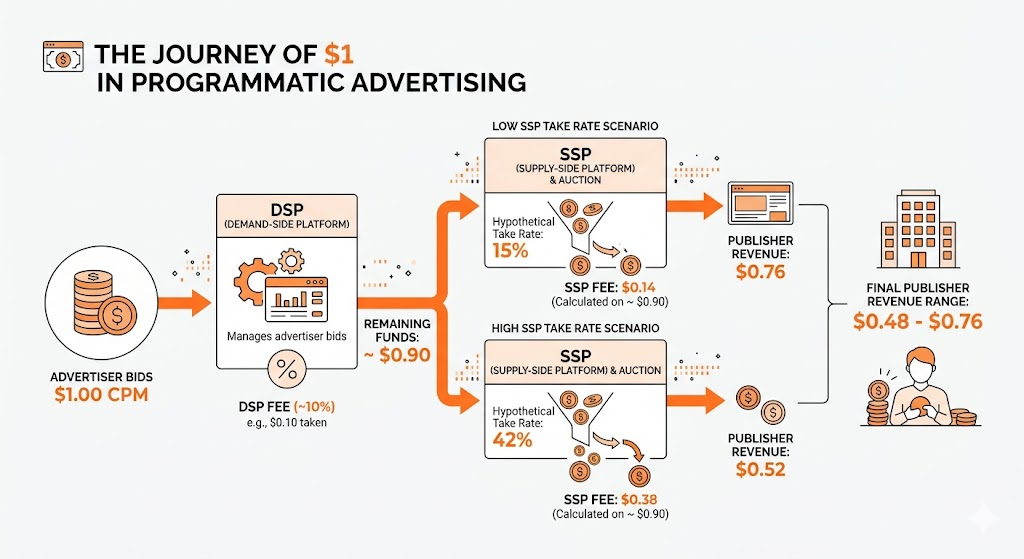
Even in a fully transparent first-price world, publishers face a second opacity layer: SSP take rates. Research shows SSP fees can vary from 7% to 42% on the same publisher’s inventory — yet most managed platforms never expose this data in publisher-facing reporting. The gap between what an advertiser pays and what a publisher receives often remains completely invisible.
What Is an SSP Take Rate?
A take rate is the percentage fee a Supply-Side Platform (SSP) deducts from the clearing price before paying the publisher. When you sign a contract, this fee is typically disclosed as a flat 10–20%. However, actual deductions can vary dramatically depending on the deal type, the buyer, and the platform’s internal mechanics.pubmatic
Independent research by Adalytics in 2024 revealed shocking discrepancies in these hidden fees. Their study found that take rates varied from 7% all the way up to 42% on the exact same publisher’s inventory. In the most extreme cases, some publishers received as little as 2 cents out of every advertiser dollar spent.
The core issue is not necessarily the fee itself, but the lack of visibility. Most platforms only provide reporting on net revenue. Because publishers never see the gross clearing price, they have no baseline to audit the actual percentage being deducted.digiday
Why First-Price Auctions Made This Worse
During the second-price era, the clearing price itself was always uncertain. Because publishers couldn’t verify the true winning bid, verifying the gross revenue was impossible anyway.
In the first-price era, the mechanics changed. The winning bid is the clearing price. Theoretically, publishers should be able to verify the entire financial chain from advertiser to payout. Yet, despite this structural shift toward transparency, most SSPs continue to report only net figures.
This makes cross-SSP fee comparison impossible without direct access to log-level data. You cannot optimize your yield if you do not know which partners are taking an unfair cut. By March 2025, major advertisers and agencies began pushing SSPs and curators for strict fee transparency, prompting publishers to demand the same visibility into their own inventory.digiday
To understand exactly where the money goes, review the breakdown of a typical programmatic transaction below.
Price Floor Strategy: Your Primary Defense in a First-Price World
In a first-price environment, price floors are the publisher’s primary tool to counter bid shading and prevent inventory from selling below fair market value. Unlike second-price floors — where the mechanics made soft floors prone to manipulation — first-price floors create a genuine revenue floor: no impression sells below your minimum. The challenge is calibration: floors set too high reduce fill rate, too low leave revenue exposed to bid shading.roxot+1
When you eliminate the second-price “haircut,” the floor price becomes a hard boundary. If an advertiser’s bid shading algorithm tries to secure your impression for $1.50, but your floor is set at $2.00, the algorithm learns it must bid higher next time to win. You are actively training the buy-side to respect the value of your inventory.
Hard Floor vs. Soft Floor vs. Target CPM
To execute a successful floor strategy, you must understand how different floor types operate under first-price mechanics.
| Floor Type | How It Works | Publisher Risk |
| Hard floor | Impression is blocked if no bid exceeds the minimum threshold. | Lost fill rate and unfilled impressions if the floor is set too high.roxot |
| Soft floor | Impressions clear above the floor; bids below trigger a lower price or alternate demand. | Easily gamed in second-price auctions; largely irrelevant and less effective in pure first-price setups.yieldbird |
| Target CPM (Google) | Google optimizes dynamically toward a CPM target rather than a strict minimum. | Less publisher control over individual impressions; outcomes vary heavily by campaign type.google |
Google’s Removal of Unified Pricing Rules (December 2025): What It Means for You
In December 2025, Google removed Unified Pricing Rules (UPR) from Google Ad Manager following antitrust scrutiny. UPR had allowed publishers to set a single floor price across all demand — its removal means publishers must now manage floor strategies per demand source, significantly increasing the operational complexity of price floor management.6smarketers+1
The removal of UPR creates a massive operational challenge for publishers relying on basic setups. Without a unified rule system, you now face a fragmented, manual process of updating floors across dozens of individual demand partners.
However, this shift also creates a distinct competitive advantage for publishers with access to granular bid-level data. Publishers utilizing self-serve platforms like PubPower can easily operationalize and automate per-SSP floor optimization, reacting to market changes faster than competitors stuck updating rules manually.headerbidding
Best Practices for First-Price Floor Optimization
Setting effective floors requires continuous calibration. Do not rely on industry averages. Use your own historical data to establish boundaries that protect CPMs without devastating your fill rates.
- Segment your floors aggressively: Never use a blanket floor. Segment your pricing by geographic market (Tier 1 vs. Tier 3), ad unit size, device type, and specific content category.blockthrough
- Use actual bid distribution data: Eliminate guesswork. Analyze your bid data and set your initial floors at the 70th to 80th percentile of historical bids for each specific segment.
- Run 2-week A/B tests: Test floor adjustments in distinct two-week windows. This isolates the exact trade-off between your gained CPM and your lost fill rate.
- Monitor SSP win rates closely: Watch your SSP performance after making a floor adjustment. A sudden drop in a specific SSP’s win rate strongly indicates they were aggressively underbidding your inventory previously.
- Revisit your floors monthly: Programmatic demand is fluid. Bid shading algorithms adapt, and seasonal advertising budgets shift constantly. Your floor strategy must remain dynamic.
Stop leaving money on the table due to poor floor optimization. See exactly how much revenue you’re leaving on the table and how your peers are fixing it.
What Auction Transparency Actually Looks Like: The PubPower Difference
True auction transparency means publishers can see the gross clearing price, SSP take rate, and net revenue for every impression — not just an aggregated net eCPM figure. PubPower’s unified real-time reporting surfaces bid-level data across 30+ SSP connections, enabling publishers to audit SSP performance, calibrate price floors with actual market data, and identify underperforming demand partners without relying on SSP-provided reporting.
For years, the ad tech industry has treated publishers like passive participants. You provide the inventory, and intermediaries tell you what it is worth. The transition to first-price auctions should have fixed this, but the data remained trapped in silos. PubPower was built to break open those silos and give publishers complete control over their revenue.
What Unified Bid-Level Reporting Enables
When you have access to unaggregated, bid-level data across all your demand sources, you transition from guessing to knowing. A unified reporting system allows you to execute advanced AdOps strategies that are otherwise impossible.
- Cross-SSP fee auditing: Stop relying on aggregated net reports. Compare the gross clearing prices against your net payouts for each individual SSP to instantly spot hidden take-rate spikes.
- Floor calibration from real data: Set your price floors based on your actual historical bid distribution, rather than relying on generalized industry benchmarks.
- Win rate visibility: See exactly which SSPs are winning, which are consistently losing, and at what specific clearing prices—all in real time.
- Bid shading detection: When your net CPMs unexpectedly drop below expected first-price clearing levels, granular data flags the algorithmic discrepancy immediately so you can adjust floors.
Here is exactly what that level of visibility looks like in practice:
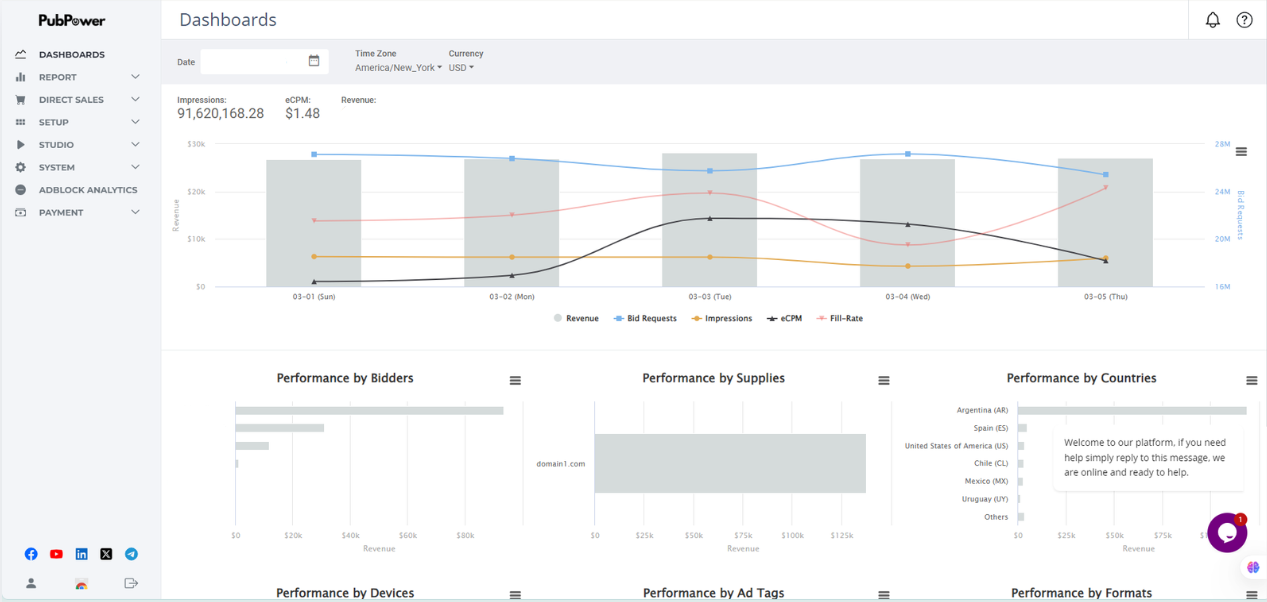
With this data at your fingertips, you control the auction dynamics instead of being controlled by them.
The Self-Serve Advantage: No Black Box, No Lock-In
Transparency is only useful if you have the autonomy to act on it. Managed services often force you to submit support tickets just to change a price floor or remove a demand partner. PubPower is a purely self-serve platform designed for publisher empowerment.
- Self-serve floor management: Adjust your price floors per SSP, per ad unit, or per geography instantly. No account manager required.
- No revenue share manipulation: PubPower’s fee structure is fully disclosed and fixed. There is no dynamic take rate variability hiding behind the scenes.
- 30+ SSP connections: Connect to a massive pool of premium demand. More simultaneous competition per impression mathematically drives up first-price clearing prices.
- GCPP certified: We operate under independently verified, stringent platform standards as a Google Certified Publishing Partner.
When you compare PubPower to traditional managed service platforms, the transparency gap becomes obvious. Most managed solutions act as a black box, optimizing for their own margins rather than exposing SSP-level take rates directly in your dashboard.
For more foundational knowledge on how these auction setups work, read our Complete guide to header bidding for publishers or explore how different architectures impact your site speed in our Client-side vs. server-side header bidding explained article.
Want to see the financial impact of removing the black box? Book a free demo
FAQ Section
What is the main difference between first-price and second-price auctions in programmatic advertising?
In a first-price auction, the winning bidder pays exactly the amount they bid. In a second-price (Vickrey) auction, the winner pays the second-highest bid plus one cent. The entire programmatic industry — including Google Ad Manager — transitioned from second-price to first-price mechanics between 2017 and 2020 to create a more transparent and consistent bidding environment across header bidding and direct demand channels.
Did the switch to first-price auctions increase publisher revenue?
Research shows 78% of publishers reported higher revenue following the industry’s first-price transition. However, the gains are partially offset by bid shading — DSP algorithms that lower bids to the minimum needed to win — which can reduce CPMs by up to 20%. Publishers who implement data-driven price floor strategies using granular bid-level reporting tend to capture more of the available first-price upside.
What is bid shading and how does it affect my CPMs?
Bid shading is an algorithm used by demand-side platforms (DSPs) — including The Trade Desk, DV360, and Amazon DSP — that analyzes historical auction data to predict the minimum bid needed to win an impression and submits that lower amount. In a first-price environment, bid shading directly reduces the clearing price publishers receive. The effect can range from negligible to 20% CPM reduction depending on vertical, inventory type, and the DSPs competing for your traffic.
What are SSP take rates and why don’t I see them in my reports?
SSP take rates are the percentage fees SSPs deduct from the clearing price before paying publishers. Independent research by Adalytics found take rates varying from 7% to 42% on the same publisher’s inventory. Most platforms only report net revenue — the amount after fees — meaning publishers cannot audit what percentage any given SSP is retaining. Accessing log-level data from your monetization platform is the only way to verify the full revenue chain.
What happened to Google’s Unified Pricing Rules?
Google removed Unified Pricing Rules (UPR) from Google Ad Manager in December 2025 following antitrust scrutiny. UPR had previously allowed publishers to set a single price floor applied uniformly across all demand partners. Its removal means publishers must now manage floor prices on a per-demand-source basis, increasing operational complexity for those without automated, self-serve floor management tools.
How do I protect my revenue from bid shading in a first-price auction?
The most effective defense against bid shading is a well-calibrated price floor strategy based on actual bid distribution data. Set floors at the 70th–80th percentile of historical bids per segment (by geography, ad size, and device), run A/B tests over 2-week windows, and monitor SSP win rate changes after adjustments. Platforms that expose bid-level data — including clearing prices per SSP — give publishers the raw material to optimize floors empirically rather than through guesswork.