

Your header bidding setup can maximize revenue — or expose your site to GDPR fines, malvertising attacks, and brand-safety violations. The difference comes down to your compliance framework. This brand safety for publishers guide covers every protection layer needed in 2026. Topics include ads.txt, sellers.json, consent management, GCPP certification, and pre-bid brand safety filters.
Contents
- 1 Key Takeaways (TL;DR)
- 2 What “Brand Safety” Actually Means for Publishers (Not Just Advertisers)
- 3 The IAB Standards Every Publisher Must Implement: ads.txt, sellers.json & SupplyChain Object
- 4 GDPR & CCPA Compliance in Header Bidding — Your Legal Obligations as a Publisher
- 5 Google Certified Publishing Partner (GCPP) — What Certification Actually Means for Your Stack
- 6 Ad Quality & Malware Prevention — Stopping Bad Ads Before They Destroy User Trust
- 7 How PubPower Handles Compliance So You Don’t Have To
- 8 Pre-Screened SSP Network + Unified Ad Quality Reporting
- 9 Frequently Asked Questions
Key Takeaways (TL;DR)
- Brand safety is a publisher’s responsibility — one malvertising incident can crater CPMs, lose advertiser trust, and spike bounce rates simultaneously.
- Three IAB standards are non-negotiable: ads.txt, sellers.json, and the SupplyChain Object. Missing any one reduces buyer trust and CPM quality.
- GDPR/CCPA compliance requires a certified CMP. It must integrate with Prebid.js and pass valid consent strings to every demand partner on every bid request.
- Working with a GCPP-certified partner like PubPower gives you an audited compliance baseline and protects your Google Ad Manager relationship.
What “Brand Safety” Actually Means for Publishers (Not Just Advertisers)
Brand safety in header bidding means ensuring that the ads appearing on your site don’t damage your reputation, violate platform policies, or trigger CPM penalties from premium buyers. While advertisers define brand safety as avoiding unsafe content environments, publishers face the inverse risk: hosting unsafe ads that drive up bounce rates and trigger demand-side exclusions.
Most brand safety conversations center on advertisers — their logos appearing next to extremist content, their campaigns funding misinformation. That framing obscures a harder truth: when a brand safety incident occurs on your site, you absorb most of the financial damage.
Why Brand Safety Problems Hit Publishers in the Revenue, Not Just the Reputation
When a publisher serves a malvertising ad or hosts flagged content, the consequences are immediate. SSPs reduce bid density, CPMs drop 15–30%, and premium buyers add the domain to exclusion lists — often without any notification to you.
The sequence typically looks like this:
- A bad creative enters through a lower-tier demand partner in your header bidding stack
- A DSP’s brand safety vendor flags your domain in post-bid verification
- Your domain gets added to a blocklist, silently reducing eligible demand
- Bid density drops, floor prices become unsustainable, fill rate erodes
- CPMs decline — and you have no visibility into why
By the time the pattern shows up in your reporting, the exclusion has already been active for days. According to IAB Europe’s Guide to Quality, unresolved brand safety incidents cause sustained CPM compression. The damage outlasts the original incident — because blocklist removal requires active outreach to each DSP individually.
This is the core problem with treating brand safety as an advertiser concern. In programmatic, your domain is your product. Any signal that degrades buyer confidence in that domain affects every auction, across every SSP, in real time.
The Three Brand Safety Threats Unique to Header Bidding
Brand safety in header bidding is a publisher’s responsibility. A single malvertising incident can devastate CPMs, advertiser trust, and user retention all at once.
Header bidding increases bid competition — that’s the point. But it also increases your attack surface. More demand partners means more vectors for bad actors. Unlike a direct campaign, header bidding pulls demand from dozens of SSPs at once. Without proper tooling, isolating the source of bad ads becomes difficult.
The three most common threats:
1. Auto-redirects (force-redirect malware)
These ads execute JavaScript on load — no click required — and forcibly navigate users away from your site. They enter through low-quality DSP demand that has passed SSP creative review but contains obfuscated redirect logic. A single auto-redirect can spike your bounce rate by 30–40% overnight before you identify the source.
2. Contextual brand safety mismatches
Ads for adult content, gambling, or controversial political messaging appearing on a family-safe or professional content site. These aren’t malware — they’re legitimate creatives that simply shouldn’t be on your inventory. Without pre-bid category filters, they’ll win auctions and serve.
3. Invalid traffic (IVT) co-mingling
Bot traffic inflates your impression counts but signals low user quality to demand-side platforms. Over time, SSPs and DSPs recalibrate their bid valuations downward for your domain. The damage is gradual and easily misattributed to seasonal factors or content changes.
Think of managing brand safety in header bidding like operating a busy airport. You control the terminal, but dozens of airlines bring their own passengers and cargo. You need a TSA layer at every gate — not just at the entrance. Pre-bid filters are your gate-level screening. Real-time monitoring is your terminal-wide surveillance system. And your SSP partner selection determines who’s allowed to operate in your airport at all.
Defending against all three threats requires depth. You need the right IAB supply chain standards, a properly integrated CMP, and a header bidding partner with pre-screened demand. The following sections cover each layer in full.
Learn more about header bidding fundamentals
The IAB Standards Every Publisher Must Implement: ads.txt, sellers.json & SupplyChain Object
Three interconnected IAB Tech Lab standards form the mandatory supply chain transparency layer for every programmatic publisher. ads.txt declares who is authorized to sell your inventory. sellers.json identifies those sellers to buyers. The SupplyChain Object (schain) embeds a traceable audit trail in every bid request. Missing any one layer reduces buyer trust and CPM quality.
Think of these three standards as a two-way authentication system. Each one closes a specific exploit: spoofed inventory, unauthorized resellers, and supply path opacity.
ads.txt — Your Public Authorization List
ads.txt (Authorized Digital Sellers) is a plain-text file at yourdomain.com/ads.txt. It declares which companies are permitted to sell your inventory. DSP crawlers check it before bidding. If an SSP isn’t listed, well-configured buyers will skip your inventory entirely.
The most common mistake: adding a new SSP partner and forgetting to update ads.txt. That single omission can block an entire demand source from competing in your auctions for days. Keep it as a live document, updated every time your SSP relationships change.
sellers.json & SupplyChain Object — Buyer-Side Verification
sellers.json is the SSP’s counterpart to your ads.txt. Each SSP publishes a JSON file that discloses the identity of every publisher in their network. Buyers cross-reference both files to independently verify both sides of the transaction. Being listed as CONFIDENTIAL in an SSP’s sellers.json — rather than named — reduces your eligibility for premium programmatic demand, as buyers applying strict supply path optimization (SPO) policies will deprioritize or exclude opaque sellers.
The SupplyChain Object (schain) takes this further. It appends a complete audit trail of every intermediary in the supply chain to each individual bid request, in real time. Buyers can see exactly how many hops exist between their DSP and your inventory — and bid accordingly. Publishers with direct SSP connections and clean schain records consistently command higher CPMs because they represent lower-risk, lower-cost supply paths.
Configuring schain correctly across 30+ SSP integrations is non-trivial — it requires per-adapter implementation in Prebid.js and ongoing validation as SSP relationships change. PubPower pre-configures schain across its entire SSP network, so publishers inherit a verified supply chain without manual setup.
GDPR & CCPA Compliance in Header Bidding — Your Legal Obligations as a Publisher
Publishers are data controllers under GDPR when they collect and process EU user data for targeted advertising — not merely processors. This means legal liability rests with you, not your SSP. Every bid request sent without a valid consent signal is a potential violation, regardless of where your servers are located.
This is the compliance gap most publishers underestimate. Deploying a CMP banner on your site is not sufficient. The consent signal that banner collects must be encoded into a TCF 2.2-compliant string and passed to every demand partner on every single bid request — in real time, before any auction runs.
How a CMP Integrates With Prebid.js — and Why the Integration Point Is Everything
A Consent Management Platform (CMP) collects, stores, and communicates user consent choices using the IAB Europe Transparency & Consent Framework (TCF 2.2). In header bidding, the CMP must be integrated directly with your Prebid.js wrapper so that consent strings are passed to every demand partner before any bid is placed.
The integration works like this:
- User lands on your page → CMP fires and either reads stored consent or presents the consent UI
- CMP generates a TCF 2.2 consent string — a standardized encoded signal containing the user’s exact consent choices per vendor and purpose
- Prebid.js Consent Management Module reads that string before initializing any bidder adapters
- The string is appended to every outgoing bid request
- Each SSP and DSP processes the signal and responds — or withholds demand — accordingly
Think of the consent string as a permission slip that travels with every auction: “This user has (or has not) consented to data processing for advertising.” If the string is missing, malformed, or based on a deprecated TCF version, well-configured SSPs will not return a bid — and you lose that revenue silently.
TCF 2.0 is no longer sufficient. Major SSPs and Google Ad Manager now require TCF 2.2 compliance, which introduced stricter legitimate interest controls and expanded publisher transparency obligations. If your CMP hasn’t been updated to TCF 2.2, audit it now.
For your CMP to be eligible for use with Google Ad Manager and AdX demand, it must appear on Google’s list of certified CMPs. Widely used options include OneTrust, Quantcast Choice, and Didomi — all of which maintain native Prebid.js integration modules.
GDPR vs. CCPA: The Key Operational Difference
GDPR requires opt-in consent before any personal data is processed for advertising. CCPA operates on opt-out — US publishers must honor “Do Not Sell or Share My Personal Information” requests but are not required to obtain prior affirmative consent.
In practice, publishers serving both EU and US traffic need CMP infrastructure that handles both signals simultaneously: a TCF 2.2 consent string for European users, and a US Privacy String (USP) for US users subject to CCPA or state-level equivalents (CPRA, Virginia CDPA, Colorado CPA).
The revenue implication of opt-out vs. opt-in is significant. EU users who decline consent under GDPR generate CPMs that are typically 40–70% lower than consented traffic — because behavioral targeting data is unavailable and only contextual demand competes. This makes CMP UX design a direct yield optimization lever. A poorly designed consent UI that defaults to “reject all” can permanently compress your EU CPMs.
Google Certified Publishing Partner (GCPP) — What Certification Actually Means for Your Stack
Google Certified Publishing Partners (GCPPs) are ad tech companies independently vetted by Google for technical expertise, policy compliance, and publisher support quality. Working with a GCPP isn’t just a trust signal — it provides a measurable compliance baseline that reduces Google policy violation risk and protects your access to premium Google Ad Manager demand.
GCPP is not a purchased badge. It requires demonstrating sustained performance across multiple dimensions: technical proficiency in Google Ad Manager and AdSense products, adherence to Google Publisher Policies, verified publisher outcome metrics, and passing periodic reassessment by Google. A platform can lose GCPP status if standards slip — which means certification reflects current, not historical, compliance.
You can find out more about GCPP List: https://www.google.com/ads/publisher/partners/find-a-partner/
What GCPP Status Means Day-to-Day for Publishers
The practical difference between a GCPP partner and a non-certified platform comes down to accountability and access.
| GCPP Partner | Non-Certified Platform | |
| Google compliance audit | Required, periodic | None |
| Publisher policy training | Mandatory | No requirement |
| Google escalation channel | Direct access | Standard support queue |
| AdX access | Included | Varies / often unavailable |
| Invalid traffic monitoring | Platform-level | Publisher’s responsibility |
Non-certified platforms carry no mandatory compliance vetting from Google — meaning if your ad stack generates a policy violation, the liability lands entirely with you. A GCPP partner maintains compliance infrastructure at the platform level, reducing the surface area of risk your AdOps team needs to manage directly.
For publishers running Google Ad Manager, this distinction is particularly high-stakes. An AdSense policy strike or AdX access suspension caused by a non-compliant demand partner can take weeks to resolve — with revenue loss accumulating daily throughout the process.
PubPower holds active GCPP certification, verified on the official Google partner directory.

If you’re currently working with a header bidding partner and aren’t certain of their GCPP status, it takes 30 seconds to verify on Google’s public directory — and the answer materially changes your compliance exposure.
Ad Quality & Malware Prevention — Stopping Bad Ads Before They Destroy User Trust
Ad quality failures — auto-redirects, malvertising, pop-unders, and offensive creatives — are the single fastest way to destroy both user experience and advertiser trust in your inventory. In header bidding, they enter through low-quality demand partners at the SSP or DSP level. Stopping them requires defense in depth: pre-bid filters, SafeFrame isolation, real-time monitoring, and rapid source isolation tools.
Pre-Bid Filters vs. Post-Bid Verification — Two Layers, Both Required
Pre-bid filters block demand based on category, format, or buyer attributes before the auction runs. Post-bid verification scans creative content after the winning bid is rendered. Both layers are necessary — pre-bid reduces your attack surface; post-bid catches what passes through, including sophisticated redirect techniques that only activate after creative caching.
Your minimum pre-bid configuration should include:
- IAB content category blocking — at minimum, IAB-26 (Illegal Content) and IAB-25 (Non-Standard Content) across all SSP adapters
- Format-level restrictions — disable auto-play video with sound, expandables, and pop-under formats unless explicitly negotiated
- SafeFrame enforcement — isolate all third-party programmatic creatives inside a sandboxed iframe that blocks ad code from accessing or modifying your page DOM
Think of SafeFrame like a glass display case: the ad is fully visible and functional, but completely isolated from your page. Creative code can render — it simply cannot touch, read, or manipulate anything outside its container.
How to Isolate the SSP Causing Bad Ads
Auto-redirects are particularly difficult to trace because the offending creative typically rotates out of the SSP’s serving system within hours of being reported. By the time you notice the bounce rate spike, the creative ID has often already been replaced.
A systematic isolation protocol:
- Pause SSPs one-by-one while monitoring bounce rate and redirect recurrence in real time
- Cross-reference GAM creative reports — match the timestamp of the redirect to a winning creative ID
- Identify the SSP that served the winning creative and escalate with the specific creative ID and timestamp
- Block the buyer or creative at the SSP level while the SSP investigates their demand source
How PubPower Handles Compliance So You Don’t Have To
PubPower’s header bidding platform is built compliance-first: all 30+ SSP connections are pre-screened for brand safety and policy compliance, the platform integrates with Google-certified CMPs for GDPR/CCPA consent management, and GCPP certification ensures your ad stack meets Google’s highest standards. Publishers get enterprise-grade compliance infrastructure without managing it themselves.
Pre-Screened SSP Network + Unified Ad Quality Reporting
Every SSP in PubPower’s network is evaluated for ad quality standards, invalid traffic rates, and policy compliance before onboarding — and monitored on an ongoing basis, not just at the point of integration. Publishers connecting through PubPower inherit a pre-vetted supply chain from day one.
What this eliminates for your AdOps team:
- Weeks of individual SSP vetting — PubPower has already done the compliance evaluation across all 30+ partners
- Manual schain configuration — pre-configured across every SSP adapter in the Prebid.js wrapper
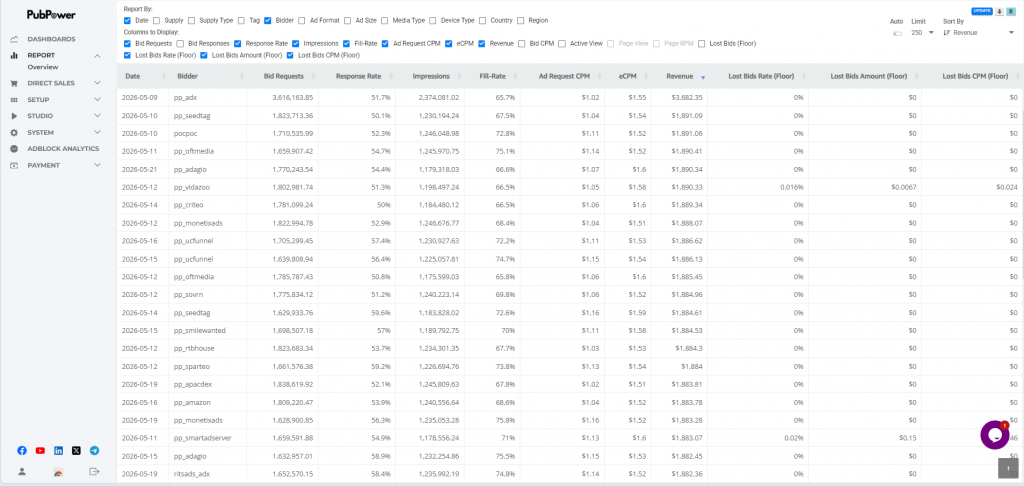
The operational difference is significant. A publisher managing compliance independently across 30+ SSPs is running a full-time monitoring operation. A publisher on PubPower has a single interface, a pre-screened network, and a 24/7 support team with a direct Google escalation channel when incidents occur.
If your current setup has gaps in any of these layers, seeing exactly where you’re exposed takes less time than you’d expect. PubPower’s AdOps team can walk through your stack and identify the highest-priority fixes in a single session.
Book a free 30-minute compliance review with PubPower’s AdOps team — we’ll show you exactly where your stack stands and what to fix first
Frequently Asked Questions
Does GDPR apply to publishers outside the EU?
Yes. GDPR applies to any publisher that processes personal data of EU residents — regardless of where the publisher’s servers or business are located. If your site receives EU traffic and serves behavioral ads, GDPR obligations apply to you.
Do I need a CMP if most of my traffic is US-based?
Yes, but the requirements differ. US publishers need a CCPA-compliant opt-out mechanism for California residents. With CPRA and expanding state-level privacy laws, a CMP that handles both TCF 2.2 (EU) and US Privacy signals is the most future-proof setup — even for predominantly US audiences.
What is TCF 2.2 and why does it matter?
TCF 2.2 (Transparency & Consent Framework) is the IAB Europe standard for encoding user consent choices into a signal passed with every programmatic bid request. Google Ad Manager and most major SSPs now require TCF 2.2 compliance. Running on an older version means some demand partners will withhold bids entirely.
How do I know if my header bidding partner is GCPP-certified?
Check Google’s official Certified Publishing Partner directory at google.com/ads/publisher/partners. GCPP status is publicly listed — verification takes under a minute and meaningfully changes your compliance exposure assessment.
How do I stop auto-redirect ads in my header bidding setup?
Enable SafeFrame on all programmatic slots, configure IAB content category blocklists in Prebid.js, and implement a systematic SSP isolation protocol when incidents occur. If a redirect appears, pause SSPs one-by-one while cross-referencing winning creative IDs in GAM to trace the source — then escalate to the SSP with the specific creative ID and timestamp.